
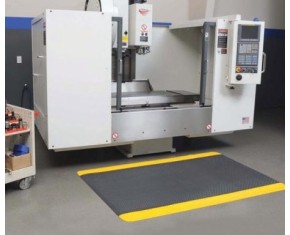
How Apache Mills Dry Environment Anti-Fatigue Mats Improve Comfort and Productivity
In manufacturing plants and distribution centers, a lot of work still happens on employees’ feet. Packing stations, assembly benches, service counters, and inspection areas often require workers to stand for long periods on hard floors, and that takes a toll over the course of a shift. The Canadian Centre for Occupational Health and Safety says anti-fatigue mats are designed to reduce fatigue from prolonged standing on hard surfaces, and that standing work can contribute to sore feet, lower-limb discomfort, muscular fatigue, and low back pain. On the Apache Mills category page, Custom MHS positions these dry-environment mats for packing orders, assembling parts, checking in customers, and use at standing desks or workstations, with the goal of reducing leg and back fatigue while improving comfort and consistency across long shifts.
What makes this category useful is that it is built specifically for dry work areas. Custom MHS states that these mats are intended primarily for dry spaces and are not the right fit for wet or spill-prone zones. That matters in real facilities because not every workstation has the same environmental conditions. In dry packing, assembly, kitting, inspection, and bench-work areas, the right anti-fatigue mat can improve day-to-day comfort without introducing a solution meant for a completely different floor condition.
Another strength of this category is the range of mat options available for different work areas and worker preferences. The page includes models such as the Apache Mills Ultimate Diamond Foot Mats at 15/16-inch thickness, Supreme Diamond Foot Mats at 11/16 inch, Diamond Foot Mats at 9/16 inch, and several 1/2-inch options, including Invigorator Black, Bubble Flex, Marble Foot, K-Marble Foot, Diamond Deluxe Soft Foot, and ArmorStep Foot Mats. The listed collection also offers a range of color options, from single-color mats to styles with up to eight color choices. That gives facility managers more flexibility when matching comfort levels, appearance, and station layouts across departments.
For manufacturing and distribution centers, the real value lies in operations. Anti-fatigue mats make the most sense in fixed standing areas where employees spend time in one spot, not in fast-moving travel lanes. Custom MHS specifically calls out packing stations, assembly benches, service counters, and work tables as strong placement areas, and advises keeping mats flat and out of tight corners or doorway situations where edges could become a hazard. That is practical guidance because the goal is not just worker comfort. It also provides cleaner workstation organization, better ergonomics, and a safer floor setup that supports productivity rather than getting in the way.
From a buying standpoint, the best dry-environment anti-fatigue mat is not necessarily the softest or thickest. Custom MHS recommends looking for stable cushioning, traction, and easy-to-clean surfaces, while CCOHS says mats should match the purpose, provide some elasticity without feeling unstable, and avoid creating slip or trip hazards. That is a useful point for operations managers because a mat has to work with the job, footwear, floor surface, and housekeeping routine. In other words, good ergonomics comes from matching the mat to the task and the environment, not just dropping any mat onto concrete and hoping for the best.
In short, Apache Mills Dry Environment Anti-Fatigue Mats are a good fit for dry manufacturing and distribution workstations where employees stand for long stretches and need better underfoot support. This category is built around comfort, posture support, and fatigue reduction in dry environments, with multiple thickness and style options that can help standardize ergonomic improvements across packing, assembly, inspection, and counter-service areas. For facilities trying to reduce strain without overcomplicating the floor plan, this is a strong category to feature.