
Industrial Equipment Experts Since 1980 | Mon–Fri, 7 AM–6 PM ET
No bots. Real experts. 866-333-0728
Get a Fast Quote
Get a Fast Quote

Medium Duty Self-Dumping Hoppers


Medium duty self-dumping hoppers are forklift-mounted dump hoppers rated for 2,000 lb. They collect light to moderate scrap, waste, and bulk material at the source and carry it to a dumpster, compactor, or central collection point. The hopper body pivots on a frame that stays on the forks, and a latch holds it upright. The operator releases the latch from the seat, the body tips forward under the weight of the contents, and it relatches automatically when empty.

 Get a Fast Quote →Read the Buying Guide →   
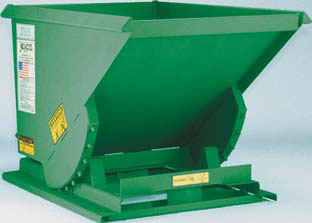
Jesco Heavy Self-Dumping Hopper


Jesco Self-Dumping Hopper, 12-gauge body, 8-gauge base


2,000-pound capacity hopper spans 1/4 to 4.0 cubic yards for light to mid-volume dumping.

 View All → 


MECO Medium Duty Hopper, 12-gauge body, 7-gauge base


MECO Medium Duty Hopper, 12-gauge body, 7-gauge base

2,000-pound capacity hopper suited for lighter scrap and waste collection.

 View All → 

MECO Medium Duty Hoppers Series 90, 12-gauge body, 1/4" gauge base


MECO Medium Duty Hoppers Series 90, 12-gauge body, 1/4" gauge base

2,000-pound capacity hopper with a reinforced quarter-inch base.

 View All → 

A 2,000 lb rating sounds like plenty until you run the numbers. Full-hopper weight equals cubic yards times the material’s density in pounds per cubic yard. A 2 cubic yard hopper of flattened cardboard at 100 lb per cubic yard weighs only 200 lb, about 10% of its rating, so you are buying volume. The same hopper filled with stone or gravel at 2,632 lb per cubic yard would weigh over 5,000 lb, and it is at its limit when only about 38% full. Size by the heaviest material you expect, and step up to heavy duty or extra heavy duty when your material is dense.

The forklift matters as much as the hopper. A hopper’s weight sits farther forward than a pallet’s, so check the hopper’s own weight plus the contents against the truck’s capacity at the actual load center, not the data plate figure. Under OSHA 1910.178, tilting forward with the load elevated is prohibited except to pick up a load or deposit it over a rack or stack, and an unattended truck must have its load engaging means fully lowered. Dump with the hopper positioned over the receptacle, use the retaining chain every time, and confirm the fork pocket dimensions match your forks.


Product Lines
Medium duty hoppers come from two brands. The Jesco self-dumping hopper has a 12 gauge body and an 8 gauge base and spans 1/4 to 4 cubic yards, the widest range here. The MECO medium duty hopper has a 12 gauge body and a 7 gauge base. The MECO Series 90 medium duty hopper keeps the 12 gauge body and adds a reinforced 1/4" steel base. All three are rated at 2,000 lb.


Selecting the Right Hopper
◆ Choose by material density first, using full-hopper weight equals cubic yards times pounds per cubic yard
◆ Choose the Series 90 for the thickest base, since steel gauge runs backwards and a lower number is thicker, with 1/4" thicker than 7 or 8 gauge
◆ Choose Jesco when you need volume above 2-1/2 cubic yards, up to 4
◆ Choose MECO when its dimensions and configuration fit your space
◆ Choose a size your forklift can lift at the hopper’s actual load center
◆ Move up to heavy duty or extra heavy duty when the material is dense

To see how a 2,000 lb hopper can weigh out at under half full on dense material, read our hoppers and tilt trucks buying guide.


Where Commonly Used
Medium duty self-dumping hoppers are commonly used on manufacturing floors, in machine shops, and in warehouses to collect light to moderate scrap and general waste.


CustomMHS carries medium duty self-dumping hoppers from Jesco and MECO. All purchases include the manufacturer’s factory warranty.

Frequently Asked Questions (FAQs)

What is a self-dumping hopper?

A self-dumping hopper is a steel container that a forklift picks up, carries to a discharge point, and tips to empty without the operator leaving the seat or handling the material by hand. A release mechanism lets the body rotate forward to dump, then returns it to the upright position for the next load. CustomMHS carries medium duty self-dumping hoppers from Jesco and MECO, backed by each manufacturer's warranty.

What does medium duty mean in this category?

Medium duty refers to a 2,000 pound capacity rating, which covers light to mid-volume scrap, waste, and bulk material collection. All three models in this group use a 12-gauge steel body and differ mainly in base thickness. If your material is dense metal scrap or the hopper cycles constantly, the heavy duty 4,000 pound or extra heavy duty 6,000 pound classes are the better match.

Why does base thickness matter?

The base takes the impact every time material drops in and takes the abrasion every time a load slides out during dumping, so it wears faster than the walls. The MECO Series 90 uses a 1/4" reinforced base for the most durability in this group, the MECO Medium Duty uses a 7-gauge base, and the Jesco model uses an 8-gauge base. Heavier or sharper material argues for the thicker base even at the same 2,000 pound rating.

What volume range should I choose?

The Jesco hopper spans 1/4 to 4.0 cubic yards, which is the widest range here. Size the volume to how often you want to empty rather than to the weight rating alone, since light, bulky material such as packaging waste fills a hopper long before it reaches 2,000 pounds. Dense scrap does the opposite, hitting the weight limit while the hopper still looks half empty, so check both numbers against your actual material.

How do medium duty self-dumping hoppers help your facility?

The main gain is removing shoveling and manual transfer from scrap and waste collection, since material goes into the hopper at the point where it is generated and comes out at the dumpster or bin without anyone touching it in between. That eliminates the bending and lifting that manual cleanup otherwise requires and reduces the trips a worker makes across the floor with smaller containers. On manufacturing floors and in machine shops, keeping a hopper at the machine also keeps scrap contained rather than accumulating around the work area, which supports both housekeeping and safe footing. Forklift compatibility means the equipment you already run handles the whole cycle, so no additional lifting equipment is needed at the station.