
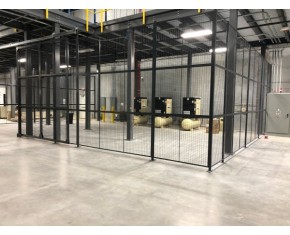
Manufacturing plants, warehouses, and distribution centers all share a common challenge. Valuable inventory, sensitive equipment, and restricted work areas need to be secured, but solid walls are expensive, block sight lines, and are difficult to reconfigure as operations change. Wire partition systems solve this problem, offering durable, code-compliant security without sacrificing visibility or airflow. Choosing the right system depends on a handful of practical factors, from wire gauge to application to access control needs. This guide walks through what to consider before purchasing a wire partition system for your facility.
What Is a Wire Partition System
A wire partition system is a modular fencing structure made of welded-wire mesh panels and steel framing, used to enclose or divide interior space in a commercial or industrial building. Unlike drywall or chain link, wire partitions install quickly, hold up under heavy use, and allow supervisors to see into secured areas at a glance. Panels, doors, and gates bolt together into configurable layouts, so systems can expand, shrink, or move as a facility's needs change.
Key Factors When Selecting a Wire Partition System
♦ Application and purpose: Start by identifying what the partition needs to protect. Tool cribs, general inventory cages, and pallet rack backing typically call for standard security fencing. Server rooms and IT equipment benefit from enclosed wire server cages that limit unauthorized physical access. Pharmaceutical and controlled substance storage often must meet DEA security requirements, which call for a dedicated DEA-rated storage cage rather than a general-purpose partition.
♦ Wire gauge and duty rating. Wire partitions are built in different duty classes. Heavy-duty systems use a thicker woven wire, commonly a 10-gauge, 2-inch-by-1-inch pattern, and suit high-security or high-traffic applications such as tool cribs and secured storage. Medium-duty systems, often built with a 10-gauge, 2-inch square pattern, are a cost-effective option for lighter partition needs, such as dividing warehouse zones or creating a visual boundary that does not require maximum security.
♦ Panel height and layout: Partition height should match the ceiling height and security requirements of the space. Full-height panels that reach the ceiling or roof deck prevent anyone from climbing over the top, which matters for high-value storage or regulated areas. Shorter panels work for zones where visual separation, not maximum security, is the goal. Measure the space carefully, since panel height, width, and post spacing all affect how many panels and posts a layout requires.
♦ Door and gate configuration: Access points should match how people and materials move through the space. Single security gates suit personnel access into smaller cribs or cages, while double security gates accommodate wider openings for equipment or pallet traffic. Expandable gates offer a flexible, adjustable opening where traffic patterns vary. Sliding doors are worth considering where swing clearance is limited.
♦ Locking and access control: Standard cam locks work for general-purpose storage, but higher-security applications often call for keyed, keypad, card reader, or proximity reader access. Regulated storage, such as DEA drug cages, typically requires a specific lock type to remain compliant. Matching the lock to the sensitivity of what is stored inside keeps the system both secure and audit-ready.
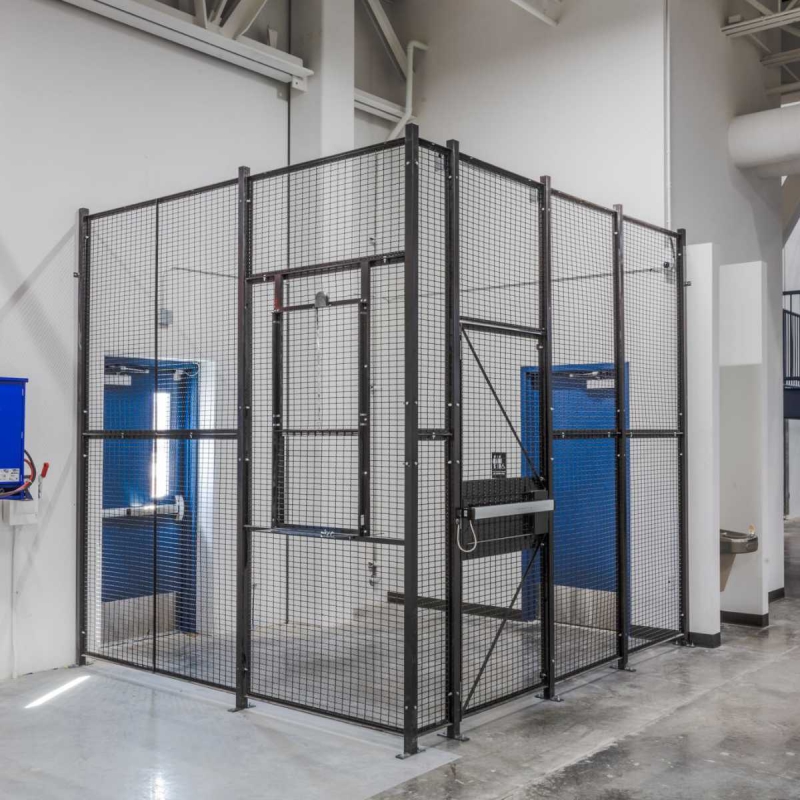
♦ Specialized enclosures: Some applications call for a purpose-built wire enclosure rather than a standard partition. Machine guards and robot fencing separate personnel from automated equipment and moving machinery. Rack enclosures secure inventory stored on pallet racking without requiring a full room build-out. Dock door cages protect loading dock openings from unauthorized entry while trucks are staged. Identifying these specialized needs early prevents having to retrofit a standard partition later.
Common Applications for Wire Partition Systems
♦ Tool cribs and equipment storage, securing valuable tools while keeping them visible and accessible to authorized staff
♦ Server and IT rooms, protecting sensitive equipment within a shared warehouse or office space
♦ Robotics and automated production cells, separating personnel from automated equipment for safety compliance
♦ Regulated storage areas, supporting DEA and other compliance requirements for controlled substances
♦ Pallet rack backing and enclosures, securing inventory stored on existing racking systems
♦ Loading dock areas, controlling access to dock doors and staging zones
Measuring and Planning Your Layout
Before ordering, measure the total perimeter of the space to be enclosed, note the ceiling or structural height, and identify where doors or gates need to be positioned for workflow. Account for any obstructions such as columns, conduit, or sprinkler heads that may affect panel placement. Most wire partition manufacturers offer standard panel sizes that can be combined to fit almost any layout, and many systems can also be custom-configured for irregular spaces.
Why Choose Wire Partitions Over Solid Walls
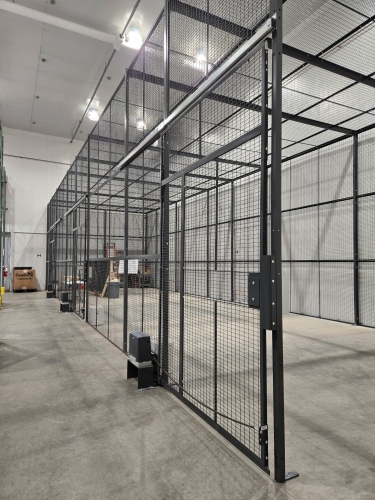
Wire partition systems offer several practical advantages over drywall or block construction. Installation is measured in hours rather than days, which limits operational downtime. Open wire mesh maintains sightlines for supervision and safety monitoring, supports natural light and airflow, and meets fire code requirements more easily than solid walls do in many jurisdictions. Because panels are modular, a partition system can be reconfigured or relocated as storage needs or facility layouts evolve, protecting the investment over the long term.
Final Considerations
Selecting the right wire partition system comes down to matching wire gauge, panel height, and door configuration to the specific application, whether that is a general tool crib, a regulated pharmaceutical cage, or a machine guard enclosure. Taking accurate measurements and identifying access control needs up front help ensure the system arrives ready for installation without costly change orders.
CustomMHS carries a full line of WireCrafters and wire partition systems, security cages, and gates, backed by each manufacturer's warranty. Visit custommhs.com to explore available configurations or speak with a specialist about sizing a system for your facility.
MORE INFORMATION
Don’t see exactly what you need?
Click the Online Configurator in the Resources section to create a custom solution for your application.