
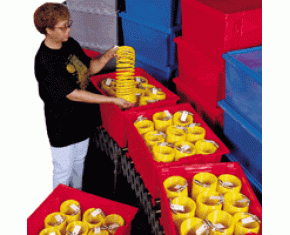
Why Stack & Nest Containers Matter in Modern Warehouses
In warehouses, manufacturing plants, and distribution centers, wasted space costs real money. Empty containers taking up floor space, inefficient trailer loading, and damaged bins from stacking mistakes all slow operations and inflate costs.
That’s where stack and nest containers come in.
Unlike standard straight-wall totes, stack-and-nest containers are designed to do two jobs well:
♦ Stack securely when full
♦ Nest compactly when empty
This simple design dramatically improves space utilization, reduces freight costs, and keeps material handling workflows moving efficiently.
What Are Stack & Nest Containers?
Stack & nest containers are reusable plastic totes engineered with tapered sides and reinforced rims.
♦ When full: They stack evenly and safely—often with or without lids—creating stable vertical storage.
♦ When empty: They rotate or nest inside one another, reducing empty container volume by up to 70%.
This makes them ideal for closed-loop systems, internal transport, order picking, and return logistics.
Why Businesses Need Stack & Nest Containers
♦ Reduce Wasted Floor & Trailer Space: Empty containers stored or shipped upright waste valuable space. Nesting containers dramatically shrink their footprint, freeing up floor space and reducing “air shipping” in trailers.
♦ Improve Warehouse Efficiency: Stackable full loads allow for safer vertical storage and easier palletization. Workers spend less time reorganizing stacks and more time moving product.
♦ Lower Freight & Handling Costs: Fewer trailers for returns. Fewer damaged containers. Less labor is required to manage inefficient storage. Over time, stack-and-nest containers pay for themselves.
4. Support Closed-Loop & Reusable Systems: These totes are built for repeat use, perfect for manufacturers, distributors, and retailers moving product between locations.
How to Use Stack & Nest Containers Correctly
Stacking (When Full):
♦ Align containers directly on top of one another
♦ Use lids if product protection or added stability is required
♦ Avoid mixing container sizes in a single stack

Nesting (When Empty):
♦ Rotate containers as designed to allow nesting
♦ Store nested containers in vertical columns to maximize floor space
♦ Secure nested loads for transport to prevent shifting
♦ Using them correctly ensures maximum lifespan and safety while maintaining consistent workflow efficiency.

Why Akro-Mils Stack & Nest Plastic Containers Stand Out
Akro-Mils stack-and-nest containers are built for industrial-grade performance, not light-duty storage.
♦ Heavy-Duty HDPE Construction
♦ Made from rugged high-density polyethylene (HDPE), these totes:
♦ Resist rust, corrosion, and moisture
♦ Won’t warp or deform under full loads
♦ Hold up to repeated stacking and nesting cycles
Chemical & Solvent Resistance
Akro-Mils containers withstand exposure to many chemicals and solvents, making them reliable in manufacturing, automotive, and industrial environments.
Stack Full, Nest Empty — With or Without Lids
Whether you need open-top access or lidded protection, these containers maintain stacking strength and nesting efficiency, giving you flexibility across multiple applications.
Common Applications
♦ Warehouse storage and order fulfillment
♦ Manufacturing work-in-process (WIP) handling
♦ Distribution and internal transport
♦ Closed-loop shipping systems
♦ Retail backroom storage
Final Thoughts
Stack and nest containers aren’t just about storage—they’re about running a tighter operation. By eliminating wasted space, reducing freight costs, and improving material flow, they directly impact productivity and profit.
Akro-Mils stack & nest plastic containers deliver the durability, consistency, and efficiency modern warehouses need—without the constant replacement cycle of lower-grade totes.