Buying Guide of the Week: Workbenches & Workstations
How high should my workbench be?
It depends on the task. Precision work goes above elbow height and heavy work goes below it. Published heights run from 18-30" for seated electronics to 36-39" for standing general woodworking. Measure to the work, not the bench top: a 4" fixture on a 34" bench is a 38" working height.
Can I set a 5,000 lb machine on a 5,000 lb bench?
Not necessarily. Bench ratings assume the load is spread across the top, and a machine puts its weight on a few small feet. A machine stand is built for that.
Which bench top is best for chemicals?
Epoxy resin, which rates high against both corrosive and carbon-based chemicals. Maple butcher block is great for impact but absorbs liquids.
Is a dissipative bench top enough for ESD protection?
No. Components can be damaged at 30 volts, while you need about 3,000 volts to feel a shock. A protected area also covers the operator, flooring, seating, containers and tools.
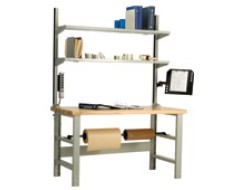
The full guide also covers manual vs electric height adjustment, cantilever bases for seated work, lighting levels from 30 to 300 footcandles, and packing station layout.
Read the full Workbenches & Workstations Buying Guide
The guide’s line that height ranges are starting points to set from the actual operator and task, and that ESD compliance is governed by the full ANSI/ESD S20.20 standard and your own verification plan.