Fixed Height vs Adjustable Height Workbenches: What Manufacturing and Distribution Centers Need to Know
Choosing the right workbench or workstation can directly impact productivity, safety, ergonomics, and workflow efficiency. In manufacturing plants, warehouses, distribution centers, maintenance shops, assembly areas, laboratories, and packing departments, the workstation is often where critical daily tasks happen.
The first major decision is whether your operation needs a fixed-height workbench or an adjustable-height workbench. Both options can be highly effective, but they serve different purposes. The right choice depends on the type of work being performed, the equipment placed on the bench, the employees using the station, and how often the task or work area changes.
A workbench that is too small, too light-duty, or poorly matched to the task can slow production, create clutter, increase employee strain, and even cause safety issues. On the other hand, the right workstation can improve organization, reduce unnecessary motion, support better ergonomics, and help employees work more efficiently throughout the day.
What Is a Fixed-Height Workbench?

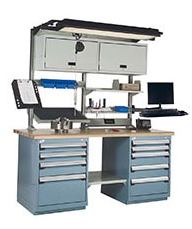
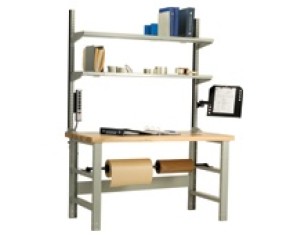
A fixed-height workbench has a set working height that does not change. It is designed for stability, repeatable tasks, and work areas where the same type of process is performed consistently.
Fixed-height benches are commonly used in manufacturing, maintenance, repair, assembly, inspection, shipping, receiving, and other industrial applications where durability and rigidity matter.
Fixed-height workbenches are often the better choice when:
♦ The task is repetitive and standardized
♦ The equipment on the bench is heavy
♦ The workstation layout is permanent
♦ The same user or team uses the bench every day
♦ Maximum rigidity and strength are important
♦ The process does not require frequent ergonomic adjustments
For example, a maintenance department may need a heavy-duty fixed-height bench for tools, vises, parts, and repair work. A manufacturing area may use fixed benches for standardized assembly steps where workers perform the same task throughout the shift.
Best Uses for Fixed-Height Workbenches
Fixed-height workbenches are usually the right choice for heavy-duty, high-load, and consistent task applications. They are practical, durable, and often more cost-effective for permanent work areas.
They work well for:
♦ Machine support
♦ Heavy assembly
♦ Maintenance and repair
♦ Tool-intensive work
♦ Shipping and receiving areas
♦ Permanent shop stations
♦ Environments with little need for ergonomic adjustment
Because fixed-height benches have fewer moving parts, they are often stronger and more rigid under heavy loads. They can also be a good fit for work areas where the process is already standardized, and the work height is not expected to change.
Why Choose a Fixed-Height Workbench?
A fixed-height workbench may be the best option when strength, simplicity, and consistency are the top priorities.
Key advantages include:
♦ Stronger and more rigid under heavy loads
♦ Fewer moving parts
♦ Often more cost-effective
♦ Better for permanent processes
♦ Ideal when bench height is already known and standardized
For many manufacturing and distribution environments, fixed-height benches provide a dependable work surface without unnecessary complexity. If your team performs the same job repeatedly at the same station, a fixed-height bench may be the most practical solution.
What Is an Adjustable-Height Workbench?
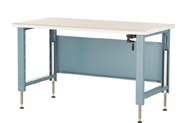
An adjustable-height workbench or workstation allows the work surface to be raised or lowered. Some models are manually adjusted, while others use crank, hydraulic, or electric lift systems.
Adjustable-height workstations are designed for flexibility. They are especially useful when multiple employees share a workstation, when tasks change throughout the day, or when ergonomics are a major concern.
Adjustable-height benches are often used in:
♦ Packing stations
♦ Order fulfillment areas
♦ Electronics assembly
♦ Inspection stations
♦ Technical work areas
♦ Multi-shift operations
♦ Sit-to-stand workstations
♦ Shared work areas with employees of different heights
In distribution centers and manufacturing facilities, adjustable-height workbenches can help employees work at a more comfortable height, whether they are standing, sitting, inspecting small parts, packing products, or assembling components.
Best Uses for Adjustable-Height Workbenches and Workstations
Adjustable-height benches are often the better choice when flexibility, ergonomics, and shared workspaces are important.
They work well for:
♦ Packing stations
♦ Order fulfillment
♦ Electronics assembly
♦ Inspection stations
♦ Technical work
♦ Multi-shift operations
♦ Sit-to-stand workflows
♦ Work areas used by employees of different heights
For example, a packing station may be used by several employees over multiple shifts. One employee may be taller, another may be shorter, and each may handle packages of different sizes. An adjustable-height workstation allows the bench to fit the worker and the task, rather than forcing the worker to adapt to an uncomfortable setup.
Why Choose an Adjustable-Height Workbench?
An adjustable-height workstation can help improve comfort, reduce strain, and support more flexible workflows.
Key advantages include:
♦ Supports better ergonomic posture
♦ Reduces strain on shoulders, neck, back, and wrists
♦ Increases flexibility for changing tasks
♦ Helps fit the station to the worker
♦ Can improve comfort and productivity over long shifts
♦ Works well in shared work areas
Poor workstation height can lead to fatigue, awkward posture, and reduced output. In fast-moving manufacturing and distribution environments, those small inefficiencies can add up quickly. Adjustable workstations can help reduce those issues by allowing the work surface to match the task and the employee.
Fixed Height vs Adjustable Height: Which Is Better?
There is no one-size-fits-all answer. The better option depends on how the workstation will be used.
Choose a fixed-height workbench for applications that are heavy-duty, repetitive, permanent, and standardized. Fixed benches are ideal for work areas where strength, rigidity, and simplicity are the most important factors.
Choose an adjustable-height workbench when the work area requires flexibility, multiple users, sit-to-stand capability, or frequent task changes. Adjustable benches are ideal for operations that want to improve ergonomics and adapt workstations for different employees or processes.
A simple way to think about it is this:
Fixed-height workbenches are best for stability and repeatability. Adjustable-height workbenches are best for ergonomics and flexibility.
What to Look for When Buying Workbenches and Workstations
Before selecting a workbench, consider the full application. A bench should not be chosen based on size or price alone. The right workstation should support the task, the worker, the equipment, and the surrounding workflow.
1. Weight Capacity
Start with load requirements. Consider the total weight of tools, parts, equipment, shelving, monitors, packaging materials, and any other items that will sit on the bench.
Ask:
♦ Will the bench support light-duty, medium-duty, or heavy-duty work?
♦ Is the load static or constantly changing?
♦ Will impact, vibration, or tool use add stress?
♦ Will heavy parts or equipment be placed on the work surface?
A bench that is too light for the application may wear out faster, become unstable, or create safety concerns. Manufacturing and maintenance environments often require heavier-duty benches than standard office or light assembly applications.
2. Work Surface Size
Choose a top size that fits the task without wasting valuable floor space.
Consider:
♦ Width and depth of the work area
♦ Room for tools, parts bins, monitors, paperwork, or packaging materials
♦ Clearance around the station
♦ Aisle space and employee movement
♦ Workflow between nearby equipment or storage areas
A bench that is too small can create clutter and slow employees down. A bench that is too large can reduce aisle space, limit movement, and make the work area less efficient.
3. Work Surface Material
The work surface should match the job. Different applications require different levels of durability, smoothness, chemical resistance, and impact resistance.
Common work surface considerations include:
♦ Resistance to impact
♦ Resistance to chemicals or moisture
♦ Protection from scratches and dents
♦ Smoothness for packing or paperwork
♦ Durability for tool work or assembly
♦ Cleanability for controlled environments
For example, a packing station may prioritize a smooth, cleanable surface, while a maintenance bench may need a tougher top designed to handle tools, parts, and impact.
4. Ergonomics
Ergonomics matter more than many buyers realize. Poor workstation height can lead to fatigue, discomfort, slower work, and reduced productivity.
Consider:
♦ Whether workers sit, stand, or do both
♦ Whether the task requires fine detail or force
♦ The average height range of users
♦ Whether multiple employees share the same station
♦ Whether the station should support sit-to-stand work
♦ Whether tools and materials are within easy reach
In manufacturing and distribution centers, ergonomic improvements can help reduce strain and support more consistent output across long shifts.
5. Workflow and Application
The workbench should support the actual process happening in the facility. A packing station, inspection station, maintenance bench, assembly bench, and tool bench may all require different features.
Consider whether the workstation needs:
♦ Lower shelves
♦ Drawers
♦ Overhead lighting
♦ Power strips
♦ Bin rails
♦ Back panels
♦ Pegboards
♦ Uprights
♦ Casters
♦ Footrests
♦ ESD protection
♦ Mobile capability
♦ Material handling integration
A workstation should make the job easier, not just provide a flat surface.
Workbenches for Manufacturing Facilities
Manufacturing environments often require workbenches that can withstand repeated use, handle heavy parts and tools, and meet demanding production schedules. Fixed-height benches are commonly used for permanent assembly, machine support, maintenance, and repair stations.
Adjustable-height benches may be better for assembly lines, inspection work, electronics production, and shared stations where different employees use the same workstation throughout the day.
For manufacturing applications, buyers should pay close attention to load capacity, work surface durability, ergonomic height, accessory options, and how the bench fits into the larger production process.
Workbenches for Distribution Centers and Warehouses
Distribution centers rely on speed, accuracy, and efficient movement of materials. Workbenches and workstations are commonly used for packing, labeling, order fulfillment, returns processing, inspection, kitting, and shipping.
Adjustable-height workstations can be especially useful in distribution environments because employees may handle products of different sizes and work across multiple shifts. A flexible workstation can help improve comfort and keep packing or fulfillment operations moving efficiently.
Fixed-height benches remain useful in warehouse settings, especially in maintenance areas, shipping departments, and permanent work zones where tasks do not change frequently.
Frequently Asked Questions
What is the difference between a fixed-height workbench and an adjustable-height workbench?
A fixed-height workbench has one set working height, while an adjustable-height workbench can be raised or lowered. Fixed-height benches are best for stable, repeatable, heavy-duty tasks. Adjustable-height benches are better suited for shared workstations, task changes, and ergonomic applications.
Are adjustable-height workbenches worth it?
Adjustable-height workbenches are often worth it when multiple employees use the same station, when tasks vary, or when ergonomics are important. They can help reduce strain and make the workstation more comfortable for different users.
When should I choose a fixed-height workbench?
Choose a fixed-height workbench when the work is repetitive, the bench layout is permanent, the load is heavy, and there is little need for height adjustment. They are commonly used for maintenance, repair, heavy assembly, and permanent shop stations.
What type of workbench is best for packing stations?
Adjustable-height workbenches are often a strong choice for packing stations because they can accommodate different workers, products, and tasks. However, fixed-height benches can also work well when the packing process is standardized, and the same employees use the station regularly.
What should I consider before buying an industrial workbench?
Important factors include weight capacity, work surface size, work surface material, ergonomics, available accessories, workflow, and whether the station will be used by one employee or multiple employees.
Final Thoughts
The right workbench can improve productivity, organization, comfort, and safety in manufacturing and distribution environments. A fixed-height workbench is usually the best choice for heavy-duty, repeatable, permanent work areas. An adjustable-height workbench is often better for flexible, ergonomic, shared, or task-changing workstations.
Before choosing a bench, review the application carefully. Think about the load, the work surface, the people using the station, the surrounding workflow, and whether the task will change over time. Matching the workstation to the job helps create a safer, more efficient, and more productive work area.
More Information
For help choosing the right industrial workbench or workstation for your facility, CustomMHS can compare fixed- and adjustable-height options based on your application, workspace, and load requirements.