Heavy-Duty Roll-Out Die Racks: How They Work, How to Choose, and When MECO Makes Sense
In stamping, molding, and heavy manufacturing, die storage isn’t “just storage.” It directly impacts changeover time, crane/forklift safety, tool damage risk, and floor-space congestion. When dies end up on the floor or buried behind other tooling, you lose time every shift, and you raise the odds of injuries and costly drops.
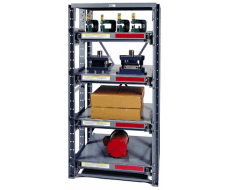
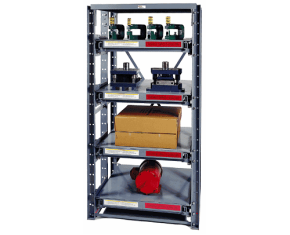
A roll-out die rack solves the core issue: it stores heavy tooling vertically while letting you pull out one shelf at a time for direct access, without rearranging the entire bay. Here’s how they work, how to size them correctly, and where MECO’s heavy-duty design is a strong fit.
What Is a Roll-Out Die Rack?
A roll-out die rack is a vertical steel storage system designed to hold extremely heavy items while allowing each shelf to extend outward independently. This gives operators direct access to stored components without removing adjacent items or climbing into the rack.
Unlike static shelving, roll-out racks are built to work seamlessly with overhead cranes and forklifts, making them ideal for dies, fixtures, and large tooling that can weigh thousands of pounds.
Why people buy them: faster access, less manual handling, better organization, safer lifting.
Why Load Capacity Matters in Die Storage
One of the most common failure points in industrial storage is underestimating weight.
The MECO Heavy Duty Roll-Out Die Rack is engineered for serious loads:
♦ Each shelf supports up to 2,000 lbs
♦ The top of the unit supports an additional 2,000 lbs
This capacity allows facilities to store dense tooling, engine components, and fixtures without stressing the structure or compromising safety. More importantly, it provides a margin of safety that’s critical in high-use environments.
How roll-out shelves improve safety and changeovers
Roll-out racks reduce two common risks:
♦ Manual handling (dragging or levering heavy tooling on the floor)
♦ Congested access (reaching past other dies or climbing into racking)
Look for these safety features:
♦ One-shelf-at-a-time roll-out to keep the unit stable
♦ Positive shelf locks in the extended position (prevents drift during load/unload)
♦ Access at workable height (less bending, less pinch-point exposure)
Use case: If your team loses 10–20 minutes per changeover searching, clearing space, or repositioning tooling, a roll-out rack often pays back quickly in uptime.
Structural Steel Frame Built for Industrial Use
MECO uses 3" structural channel steel throughout the frame — not formed sheet metal. This matters because structural channel steel resists twisting and deformation under repeated heavy loads.
The uprights are punched on 2" vertical centers, allowing shelf heights to be adjusted as tooling needs change. That flexibility helps extend the rack's useful life as inventory evolves.
Configurations That Fit Your Operation
No two facilities store the same tooling, which is why MECO offers multiple configuration options:
♦ Three different heights
♦ Three shelf depth options
♦ Three-shelf or four-shelf models
♦ Add-on units available for future expansion
This modular approach allows facilities to start with what they need today and expand later — without replacing existing equipment.
Space Efficiency and Facility Organization
Heavy tooling stored on the floor consumes valuable square footage and creates safety hazards. Vertical die racks:
♦ Maximize vertical space
♦ Keep aisles clear
♦ Improve visual organization
♦ Reduce time spent searching for tools
For facilities struggling with cluttered floors or inefficient layouts, roll-out die racks often deliver immediate operational improvements.
Shipping and Finish Considerations
The MECO rack ships knocked down, which significantly reduces freight costs — a major factor for heavy steel equipment. Once installed, the gray enamel finish provides a clean, professional appearance that holds up well in industrial environments.
Common Applications Across Industries
MECO Heavy Duty Roll-Out Die Racks are commonly used in:
♦ Manufacturing plants for dies, molds, and fixtures
♦ Tool & die shops for organized tooling storage
♦ Automotive and aerospace facilities for engines and transmissions
♦ Warehouses and distribution centers for dense, heavy inventory
♦ Maintenance departments for spare parts and tooling access
If it’s heavy, expensive, and frequently accessed, this type of rack is usually the right answer.
Final Takeaway: When a Roll-Out Die Rack Makes Sense
A heavy-duty roll-out die rack isn’t just a storage product — it’s an investment in safety, efficiency, and scalability. MECO’s design checks the boxes that matter most: load capacity, structural integrity, accessibility, and future expansion.
For facilities handling heavy tooling daily, upgrading to a properly engineered roll-out rack often pays for itself through reduced downtime and safer workflows.