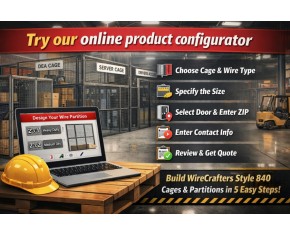
Design WireCrafters Style 840 Wire Security Fencing in 5 Easy Steps
When a manufacturing plant or distribution center needs secure storage, controlled access, or protected work areas, speed matters. You do not want to waste time going back and forth trying to explain layouts, door options, panel types, and site requirements just to get pricing. That is exactly why our online configurator exists.
With our online configurator, you can design WireCrafters Style 840 Wire Security Fencing for a wide range of industrial applications, including warehouse partitions, controlled-access enclosures, DEA cages, server cages, driver access cages, tool cribs, and secured storage areas. Instead of starting from scratch, the configurator walks you through a clear five-step process that helps manufacturing and distribution teams build the right solution and request a fast quote.
Why Style 840 Wire Security Fencing Works in Industrial Facilities
Manufacturing and distribution environments need security solutions that do more than block access. They need systems that protect inventory, control entry, maintain visibility, and integrate with active operations without causing unnecessary disruption.
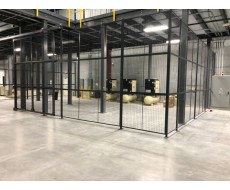
That is where Style 840 Wire Security Fencing stands out. Its open-wire design helps maintain sightlines, allows light to pass through, and supports airflow and fire suppression coverage. At the same time, it creates a strong physical barrier around high-value inventory, restricted equipment, server areas, maintenance supplies, pharmaceutical storage, and other sensitive spaces. Your product pages specifically position these systems for use in warehouses, distribution centers, manufacturing facilities, server environments, DEA storage, and controlled-access applications.
For industrial buyers, this system is practical for both security and operations. It helps facilities stay organized, improve access control, and protect assets without closing off the workspace the way solid walls often do.
Step 1: Choose the Right Wire Pattern, Cage Type, and Configuration
The first step in the configurator is where the core design starts.
You can choose between:
- 10 gauge 2" x 1" wire pattern (Heavy Duty)
- 10 gauge 2" x 2" welded wire (Medium Duty)
This gives buyers a straightforward way to match the level of security and durability to the application. Heavy-duty woven wire is a strong choice for more demanding environments or higher-security needs. Medium-duty welded wire can be a smart fit when you want secure separation with a different mesh pattern and cost profile.
From there, you choose the type of cage or enclosure you need. Common options include:
- Warehouse partitions
- Secured storage areas
- DEA cages
- Server cages
- Driver access cages
- Tool cribs
- Other custom-controlled-access enclosures
Then you select the configuration. Depending on the application and layout, that may include one-wall, two-wall, three-wall, or four-wall setups. This matters because every facility is different. Some spaces can use existing building walls, while others need a fully enclosed freestanding cage.
Step 2: Specify the Size
Once the product style and configuration are selected, the next step is to specify the size.
This is where the configurator becomes especially useful for manufacturing and distribution centers. Real facilities rarely have one-size-fits-all requirements. You may need to secure a compact server area, create a larger warehouse partition, or build a dedicated driver access cage at a dock location. In other cases, you may be setting up a DEA cage, evidence storage area, or inventory control enclosure with very specific dimensions.
By entering the required size, you move from a generic idea to a real project scope. That helps your quote come back faster and with fewer revisions.
Step 3: Select the Door Type and Enter the Ship To ZIP
Access control is a big deal in any industrial security project. That is why the configurator includes door selection in the process.
If a door is needed, you can choose the type that fits your operation. That may depend on traffic flow, clearance requirements, space constraints, and how often personnel need to enter and exit the enclosure.
For example:
- A hinged door may work well for standard access points
- A sliding door can make more sense where swing clearance is limited
- Controlled-access applications may require locks, keypads, or access-control hardware, depending on the site
After that, you enter the ship-to ZIP code, which helps move the quote process along and enables more accurate freight and delivery planning.
This step matters more than many buyers realize. In manufacturing and warehouse operations, delivery conditions can affect timelines, unloading needs, and total project cost. Getting that information in early saves time later.
Step 4: Enter Contact Information
This part is simple, but it matters.
By providing your contact information, you make it easier for the quote team to follow up quickly if anything needs clarification. That keeps the project moving and reduces the risk of delays due to missing details.
For procurement teams, plant managers, facility managers, and warehouse leaders, that means less time chasing updates and more time getting the right security solution in place.
Step 5: Review and Submit for a Fast Quote
The final step is to review your selections and submit the request.
This is where you confirm the important details:
- Wire pattern
- Cage type
- Configuration
- Size
- Door type
- Ship-to ZIP
- Contact information
Once submitted, the configurator gives your team a much cleaner starting point for a fast quote. That is the real value here. Instead of trading multiple emails just to explain the basics, you are already sending a more complete picture of the application and layout.
Common Applications in Manufacturing and Distribution Centers
The configurator is especially useful because Style 840 systems support a wide range of industrial use cases. These are not niche products. They solve everyday facility problems.
Common applications include:
Warehouse Partitions
Create separated areas for inventory control, returns, high-value storage, or operational zoning inside a warehouse.
Controlled Access Enclosures
Restrict access to tools, maintenance supplies, equipment, or sensitive inventory while maintaining high visibility.
DEA Cages
Secure pharmaceuticals or regulated materials in a way that supports controlled access and organized storage.
Server Cages
Protect network hardware and IT equipment inside industrial facilities, distribution operations, and data-support environments.
Driver Access Cages
Create a safer, more controlled area for drivers and dock-related access points in busy shipping and receiving zones.
Tool Cribs and Secured Storage Areas
Reduce loss, improve accountability, and keep valuable assets protected without sacrificing accessibility.
Your site also highlights broader applications, including machine guarding, maintenance cages, pallet rack backing, and robotic work-cell barriers, which shows how flexible the Style 840 system really is.
Why Use an Online Configurator Instead of Starting from Scratch
The biggest advantage is efficiency.
Manufacturing and distribution buyers usually know what problem they are trying to solve. What slows them down is turning that need into a clean quote request. The configurator addresses that by providing a structured process.
It helps you:
- Narrow down the right wire type
- Choose the right enclosure application
- Match the layout to the facility
- Account for door and access needs
- Speed up quote turnaround
- Reduce confusion and back-and-forth
That is good for both the customer and the quote team. Everyone wastes less time.
Final Takeaway
If you need a better way to plan wire security fencing, warehouse partitions, DEA cages, server cages, controlled-access enclosures, or driver-access cages, our online configurator offers a faster, more organized path to a quote.
In just five steps, you can choose the wire pattern, select the enclosure type, specify the size, add door and shipping details, enter contact information, and submit everything for review. For manufacturing plants and distribution centers, that means less guesswork, faster pricing, and a better way to design a security solution that actually fits the operation.