
Why the MFG 212109 Conductive Fiberglass Conveyor ESD Tray Is a Smart Choice for Manufacturing and Distribution Centers
In electronics manufacturing and ESD-sensitive distribution environments, product damage does not always come from impact or mishandling. Static discharge can cause immediate failures or latent defects that manifest later in the field, which is why controlled handling matters across manufacturing, testing, shipping, and storage workflows. The EOS/ESD Association notes that ESD damage can occur throughout manufacturing, test, shipping, handling, and field service, and that effective protection depends on a broader ESD control program built around defined protected areas, charge reduction, dissipation, and product protection.
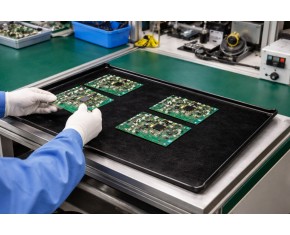
That is where the MFG Model 212109 Conductive Fiberglass Assembly Conveyor ESD Tray fits in. According to the product page, this tray is designed to protect sensitive electronic components, assemblies, and circuit boards from electrostatic discharge during production, assembly, and storage. It measures 28 inches long by 21-1/2 inches wide by 1 inch high, making it a low-profile option for conveyor systems, storage racks, and work-in-process handling. The listing also states that its static-dissipative performance is permanent and remains consistent, unaffected by humidity, washing, or flux solvents.
One of the strongest reasons to use this tray is its durability. Many facilities need more than a disposable or light-duty tray, especially when parts move repeatedly between stations or ride through automated systems. CustomMHS describes the 212109 as a robust fiberglass tray built to withstand heavy industrial use while resisting impacts, chemicals, and corrosion. The tray is also rated for temperatures from -60°F to 250°F and resists cutting oils, greases, solvents, mild acids, and alkaline solutions within the listed pH range, which makes it practical for demanding production and lab environments.
For manufacturing operations, that translates into better control over work-in-process movement. Smooth surfaces, rounded edges, and the absence of sharp corners help the tray integrate more cleanly into automated conveyor systems and handling processes. Its low-profile design also supports efficient transfer, staging, and temporary storage of sensitive assemblies without introducing bulky packaging or awkward handling steps. When you are trying to protect boards, subassemblies, or finished electronic components while keeping the flow moving, a conductive fiberglass conveyor tray like this offers a more purpose-built solution than standard plastic totes or general-purpose trays.
For distribution centers, the value is a little different but just as important. Not every DC needs an ESD tray, but facilities that store, sort, kit, inspect, or ship sensitive electronics do. In those environments, using a tray designed for static-safe handling can support more consistent handling practices between receiving, inspection, light assembly, packing, and storage. The product page also notes that the tray is lightweight yet strong and features a non-porous surface resistant to microbial contamination, which helps from both a handling and housekeeping standpoint.
There is also a safety and compliance angle. The product page says the tray meets or exceeds ANSI/ESD standards, and the EOS/ESD Association states that ANSI-accredited electrostatics standards are the industry framework companies use to build ESD control programs. That does not mean a tray alone creates a full ESD-safe environment. But it does mean this product can be a useful material-handling component inside a properly managed ESD control process.

In short, the MFG 212109 Conductive Fiberglass Conveyor ESD Tray is a good fit for electronics manufacturers, labs, and ESD-conscious distribution operations that need reliable, repeatable protection for sensitive parts. It combines permanent static-dissipative performance, fiberglass durability, chemical resistance, wide temperature tolerance, and conveyor-friendly design in one low-profile tray. If your facility handles circuit boards, assemblies, or other ESD-sensitive products, this is the kind of tray that helps tighten up process control, reduce avoidable damage risk, and support cleaner, more consistent material flow.